Application description
The CMe3100 is, directly out of the box, a powerful and versatile M-Bus Metering gateway. It can be extended in several ways using a flexible model for license and add-on upgrades.
While there are many ways to utilize the potential in the CMe3100, its core application areas are:
- Quick and simple metering with integrated statistics
- Metering and local integration with PLC/DCS
- Full Gateway integration using e.g., DLMS or REST
Additionally, all features can be used in a mix to address application specific needs. It also fully supports all types of utility meters that are M-Bus or Wireless M-Bus compliant.
Metering and local integration with PLC/DCS
For standard applications with a medium requirement for integration, the CMe3100 is very quickly setup using its predefined readout schedules and metering reports (Push Reports). Once the meters have been installed, the device can be configured to readout meter values at specific time intervals and compile them in a suitable report format to be sent to a receiving system. Reports are transmitted using standardized internet protocols, such as SMTP (e-mail), FTP, HTTP or MQTT.
Thanks to the device’s built-in M-Bus decoder, meter values can be delivered in a human readable form with correct precision and unit.
The built-in database, storing all meter values locally in the CMe3100, provides a solid base for its system robustness. All Push Reports have intelligent retry mechanisms that automatically schedules retries for failed reports including all values for which previous transmissions have failed.
The built-in database also enables excellent and reliable options for local integration with a Digital Control System (DCS) or a Programmable Logic Controller (PLC). These types of system components are usually found in real-estate systems to control, for example heat and ventilation. Interfacing systems may choose to connect using BACnet, Modbus, M-Bus, or JSON (TCP/IP) to retrieve meter values directly from the CMe3100 without affecting its normal operation or having to communicate with the M-Bus meters directly.
If the CMe3100 is used in a mixed application with metering reports and high demand for real-time meter values being supplied to a PLC or a DCS, there is an additional mode available, Continuous Readout Mode. When activated, the CMe3100 reads all meters as frequent as possible and makes the readouts available to interfacing systems but without affecting the reporting mechanism. This enables metering reports to be configured independently from how the interfacing system’s meter value requirements.
Full Gateway integration using DLMS or REST
For demanding applications that require vertical integration, the CMe3100 supports the REST or DLMS protocols. Using these protocols, meter values and configuration settings are available without having to bother about specific details of the M-Bus metering format. A head-end system may access most current readouts, historical values as well as log information, Meter Lists and change notifications. CMe3100 is certified by DLMS organization.
The built-in database, storing all meter values locally in the CMe3100, provides a solid base for its system robustness as historical meter can be recovered by the head-end system at any time.
Full Gateway integration
Features
The CMe3100 M-Bus Metering Gateway has the potential to read, convert and deliver meter values from all types of M-Bus meters, regardless of manufacturer. This makes the device quick and easy to integrate into an existing M-Bus system. The key features of the product include:
- An integrated M-Bus Master which can drive up to 32 unit loads (32T). By using Elvaco M-Bus Masters it is possible to extend this number up to 512 unit loads.
- Customized meter value reports via HTTP, FTP, e-mail or MQTT.
- A built-in web interface for easy configuring of settings.
- Remotely updatable firmware.
- Meter value integration via BACnet, MODBUS, REST, JSON-RPC and DLMS.
Compatibility and extensions
Licensing scheme
The CMe3100 is equipped with a flexible licensing scheme that allows its capabilities and features to be enhanced through the addition of license files. This allows for both cost-effective customization at the purchase point as well as the possibility to later extend the product functionality without changing the hardware.
Licenses are distributed as files, bound to a specific serial number. A license file may contain several licensing options, but an individual file is always required for each product.
There are two main categories of licenses available, performance and feature licenses.
The performance licenses determine, from a software perspective, how many meters may be used with the device. Licenses range from 8 to 512 meters in steps of 8, 32, 64, 128, 256 and 512.
Feature licenses enable new services in the product, for example integration protocols such as BACnet, Modbus, REST, JSON and DLMS.
To learn more about the different licenses available, contact the sales team at Sycous.
Integration with other products
The CMe3100 can be used in combination with an M-Bus Master from Elvaco to increase the number of slave devices it is able to drive (the device can by default drive up to 32 unit loads, where one load equals 1.5 mA). It can also be combined with an Elvaco Wireless M-Bus Receiver to receive meter reading from wireless meters using the Wireless M-Bus Protocol.
The CMe3100 is compatible with a wide range of meters, including:
- ABB electricity meters using IR interface communication.
- All types of M-Bus meters, regardless of manufacturer.
- The following temperature and humidity sensors, manufactured by Elvaco: CMa10, CMa10W, CMa11, CMa11W, CMa12W, CMa20, CMa20W and the Elvaco Sense family.
Using the product with wired and wireless M-Bus
The CMe3100 can be used together with wired M-Bus meters, wireless M-Bus meters, or a combination of both. The integrated M-Bus master can handle up to 32 unit loads so for smaller systems, the CMe3100 may operate independently. For larger systems, the number of M-Bus devices the CMe3100 can drive is easily extendable through any of Elvaco’s M-Bus Masters in combination with a license upgrade.
CMe3100 has a built-in system for wireless encryption key handling and can easily be integrated in a wireless M-Bus metering system. To receive wireless meters, the CMe3100 needs to be complemented with an Elvaco wireless M-Bus receiver.
Parts overview
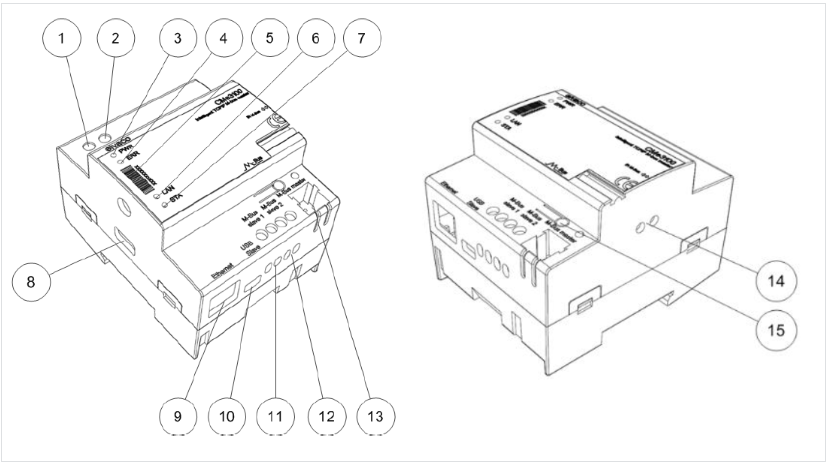
Buttons and indicators
- Power supply L
- Power supply N
- Green LED
- Red LED
- Serial number
- Yellow LED
- Blue LED
- USB master
- Ethernet connection
- USB slave
- M-Bus slave 1
- M-Bus slave 2
- M-Bus master
- IR interface
- Push button
LED indications
The product is equipped with LED lights. The green LED displays current operations, the red LED indicates error, and the yellow LED displays the network status. The following tables provide an explanation of each LED indication.
Green LED
| Green LED | Product state | Visual |
|---|---|---|
| Permanently off | No power or boot mode |
|
| Short flashes | Normal operation |
|
| 50 percent on/50 percent off | Booting in progress |
|
| Permanently on | Firmware error indication |
|
Red LED
| Red LED | Product state | Visual |
|---|---|---|
| Permanently off | Normal operation |
|
| 50 percent on/50 percent off | Network problems or booting in progress |
|
| Permanently on | M-Bus master short circuit protection active |
|
Yellow LED
| Yellow LED | Product state | Visual |
|---|---|---|
| Permanently off | Network connection to Ethernet port is missing |
|
| Short flashes | Ongoing communication on network |
|
| Permanently on | Ethernet port connected to network |
|